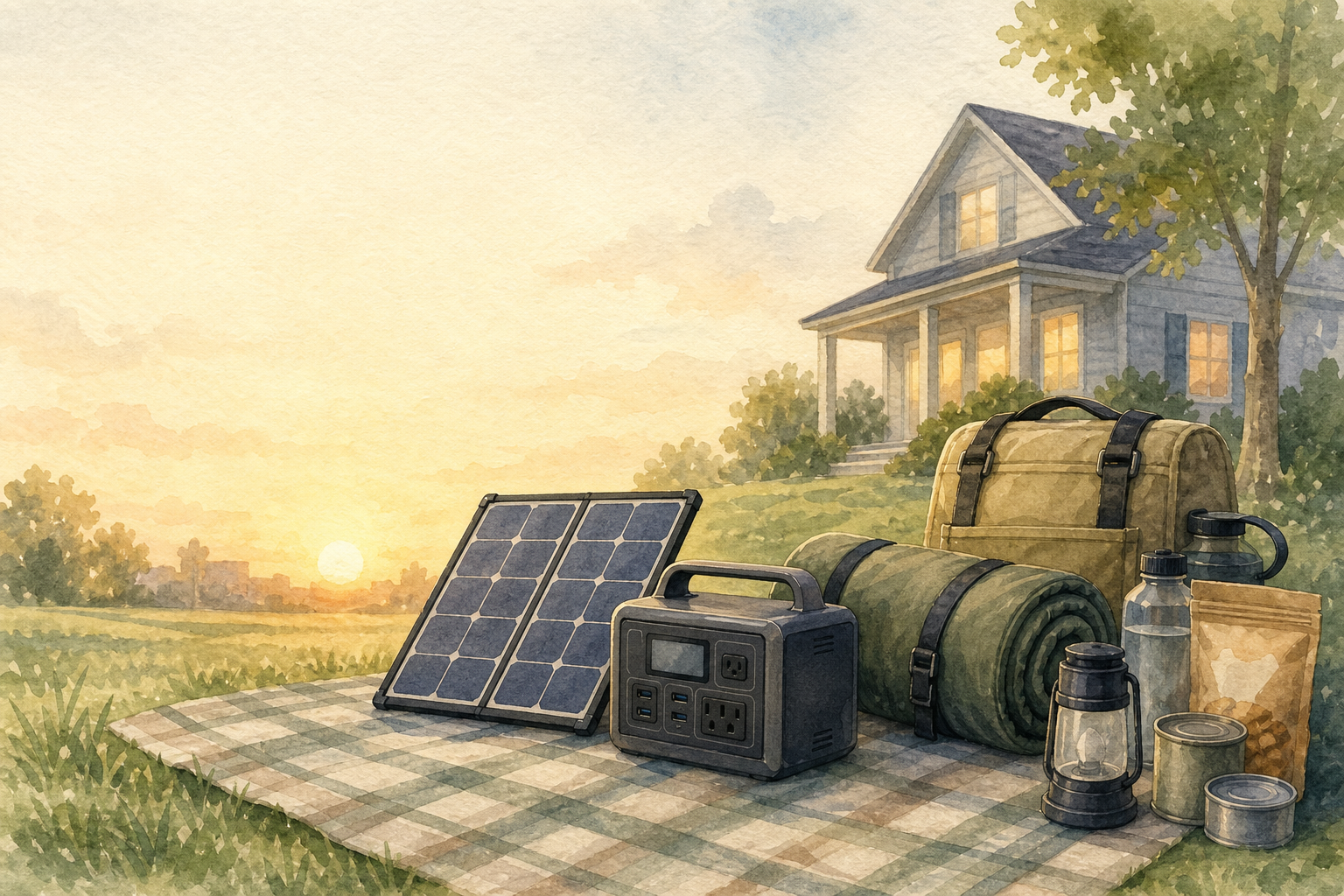
Budget Solar Panels for Home Outage Backup
Aug 03, 2026
Why small-scale solar matters for preparedness
For most families preparing for outages, full rooftop systems are overkill and expensive. Smaller solar solutions deliver targeted resilience for critical items like phones, lights, a mini-fridge, or medical devices. This guide focuses on three practical categories you will see on sale: plug-and-play solar generators, portable foldable panels, and minimal rooftop panels for essential loads.
Quick overview of the three budget paths
- Plug-and-play solar generator kits: These pair a compact power station with a matching solar panel or two. They are easiest to use and require no wiring. Good for phone charging, lights, CPAPs with low draw, and small appliances.
- Portable foldable panels: Lightweight and easy to aim at sun. They are ideal for topping up power stations, camping, and rapid deployment. Expect variable durability and connector types.
- Minimal rooftop setups: Two to four small rigid panels mounted to a roof or pole feeding a battery-backed inverter. Lower profile than full systems and suited to powering a subset of household circuits, but may need a pro for safe installation.
How to evaluate cost per watt
Cost per watt is a simple comparison metric. Divide the price by the panel watt rating. Use the same units for all comparisons.
- Example: a 200 watt panel priced at $300 gives $300 / 200 W = $1.50 per watt.
- When a kit bundles a panel and power station, calculate the panel cost per watt separately only if you can reasonably allocate cost. Often the convenience of the bundle justifies paying a premium.
- Compare apples to apples. Portable foldables often have higher price per watt than rigid panels because they include a carrying case and charge controllers built in.
Runtime math when paired with battery packs
Use a simple formula to estimate runtime: usable hours = battery capacity (Wh) × usable fraction ÷ device wattage. Account for inverter losses when powering AC devices.
- Battery capacity: power stations are rated in watt-hours (Wh). A 500 Wh unit holds 500 watt-hours of energy.
- Usable fraction: many batteries recommend not discharging below 10 to 20 percent. For quick math assume 90 percent usable. For battery chemistry or device safety, follow manufacturer guidance.
- Inverter losses: assume about 10 percent loss when converting DC to AC. For conservative estimates, use 10 to 15 percent.
Example calculations:
- Phone charging: A 10 watt phone charger on a 500 Wh power station yields about 500 Wh × 0.9 ÷ 10 W = 45 hours ignoring minor losses.
- LED lighting: A 15 watt LED lamp on the same 500 Wh station runs roughly 500 × 0.9 ÷ 15 = 30 hours.
- Mini-fridge: A small compressor fridge averaging 60 W when running will last 500 × 0.9 ÷ 60 = 7.5 hours of runtime. Remember compressor duty cycle reduces continuous draw in practice.
Practical tradeoffs: what you gain and what you give up
- Plug-and-play kits: Very convenient and safe for nontechnical users. They often include MPPT controllers for faster charging. Tradeoff is higher upfront cost per watt and limited expandability.
- Foldable panels: Best for portability and point-and-shoot setup. They charge portable power stations well and are low cost to try. Tradeoff is lower physical durability and typically higher cost per watt than rigid panels.
- Minimal rooftop: More efficient use of roof space and better long-term value per watt. Tradeoff is installation complexity, potential HOA or permit requirements, and longer lead time to deploy during an outage.
What makes a sale actually worth buying
- Real discount size: A coupon that drops price by 5 percent is rarely meaningful for solar gear. Look for 15 percent or more on higher-ticket items, or bundle savings that include cables, mounting, or extra panels.
- Seller legitimacy: For Amazon listings check seller ratings, return history, and warranty registration process. Third-party listings can have lower prices but verify warranty transferability.
- Included components: Many solar deals omit MC4 adapters, charge controllers, or proper MC4-to-DC cables. A cheap panel without connectors may end up costing more once you add parts.
- Warranty and support: Solar panels and power stations are long-term purchases. A three to five year combined warranty on the power station and at least a 1 year parts warranty on panels is preferable for budget buys.
- Timing: Seasonal sales, holiday promos, and certified refurbished items can be good. But confirm return windows so you can test performance at home.
Deal watch checklist for Amazon and other retailers
- Confirm the original price and check price history tools before assuming the discount is real.
- Read recent reviews that mention electrical connectors, cable length, and real-world wattage output in good sun.
- Verify whether the listing is fulfilled by Amazon or a third party and what the return process looks like.
- Check whether the sale includes all necessary parts to operate the kit out of the box.
- Search for manufacturer support contacts and warranty registration steps before purchase.
Quick configuration examples for budget-conscious families
- Micro backup for basic needs: 100 to 200 W foldable panel + 300 to 500 Wh power station. Targets: phone, lights, router, a few small appliances. Low cost, highly portable, and good for short outages.
- Family weekend backup: Two 100 to 200 W panels + 1000 Wh power station. Targets: small fridge, several phone charges, LED lighting, and occasional microwave use in rotation. Offers multi-day capability when shaded and used conservatively.
- Minimal rooftop critical loads: Two to four 300 W rigid panels, a 1000 to 2000 Wh battery, and a small inverter to handle essential circuits only. Consider professional install for safety and code compliance.
Practical shopping tips
- Buy panels and power stations with matching input voltages or include an MPPT controller to avoid charging inefficiencies.
- Favor kits with MPPT controllers when possible. MPPT improves charging speed, especially in nonideal sun angles.
- Consider weight and storage. Foldables are lighter but may need more careful handling.
- Plan for cables, connectors, and protective storage. A good case and weatherproofing extend service life.
Founder perspective and how to use deal feeds
As the founder of a deal-first prepper site, the goal has always been simple: reduce the time from curiosity to purchase with clear, practical signals about value. For solar gear that means surfacing verified discounts on kits that include the parts you actually need, not just headline markdowns. Use curated deal feeds to compare similar bundles quickly and set alerts for the type of kit you want.
Where to start right now
If you want a low-friction start, pick a plug-and-play kit sized to your most important device. If you already have a compatible power station, prioritize foldable panels with MPPT. For longer term household resilience, consider phased purchases: start portable, then add rooftop panels when finances and permits allow.
FAQ
-
How many panels do I need to run a house?
Most homes require many kilowatts to run every circuit. For outage readiness, focus on essential loads only and size panels and batteries to sustain those items. A small kit can support critical devices for days if you manage consumption.
-
Are portable panels safe to use?
Yes, when used according to manufacturer instructions, with correct connectors and fusing. Keep panels dry and secure, and avoid DIY wiring without proper knowledge.
-
Is an MPPT controller worth the extra cost?
For variable sun angles and higher power panels, MPPT often improves charging efficiency and can pay for itself in faster recharge times during limited sun.
Smart prepping is about matching capability to risk and budget. Use the cost-per-watt math, runtime formulas, and deal checklist here to decide quickly. For busy shoppers, curated feeds that highlight verified solar kit savings can shorten the buying process and reduce the chance of missing real discounts.
Want current, AI-curated solar and backup power deals vetted for preppers? Check deal feeds that surface verified bundles, include component lists, and flag meaningful discounts so you can decide faster and spend less time digging through listings.
Discover More Featured Deals
Explore our hand-picked selection of the best deals, curated daily just for you.