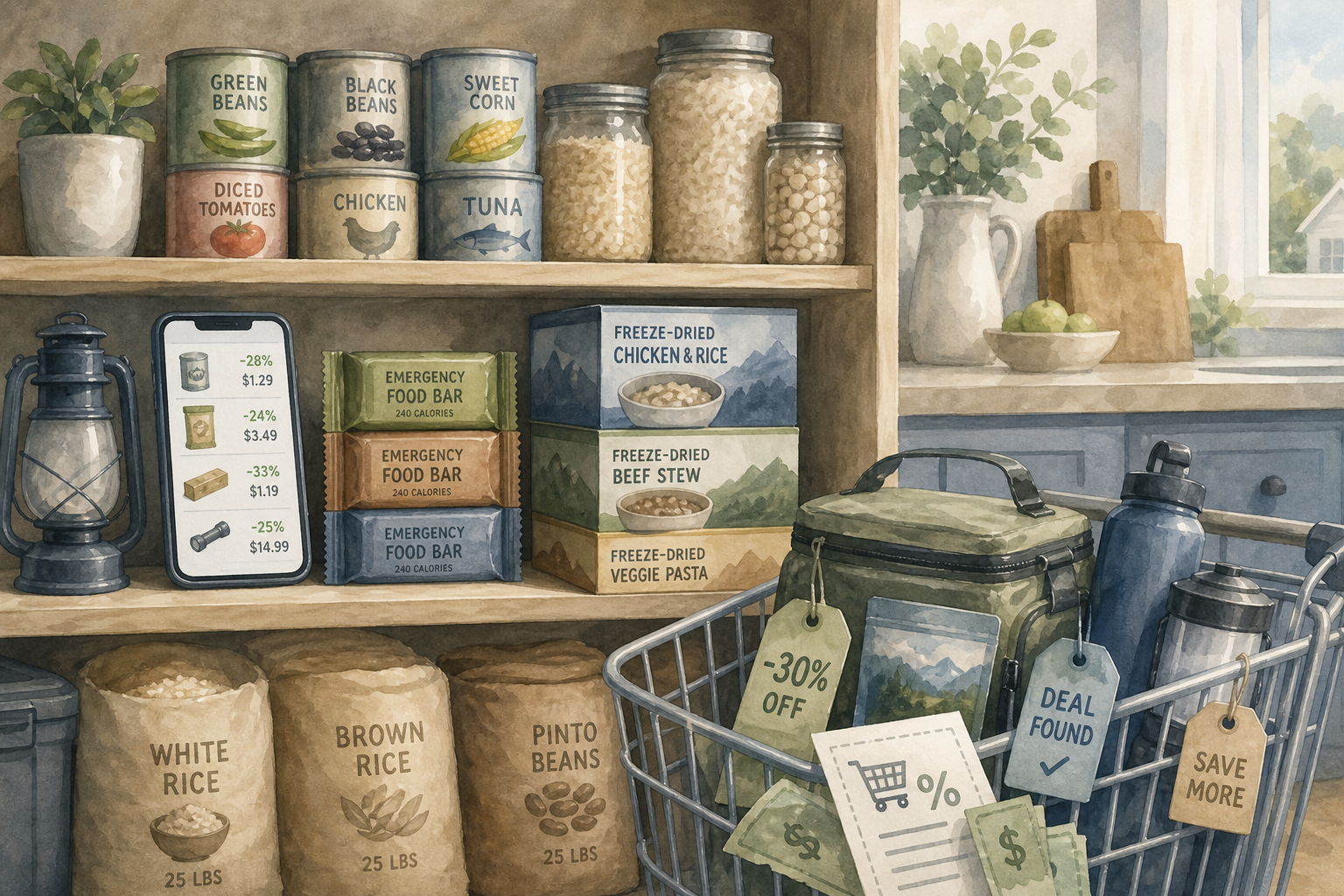
Emergency Pantry on a Budget with Food for Less Tips
Jun 26, 2026
Why a 30-day emergency pantry can be affordable
Preparing a month of food for your household does not need to break the bank. With a simple plan, basic math, and a mix of weekly in-store bargains plus timely online deals, suburban families and beginner preppers can assemble a balanced, shelf-stable supply that rotates with normal grocery shopping. This article focuses on money-first tactics and actionable shopping steps you can use at discount grocers, including Food 4 Less style stores, and online marketplaces.
Set goals first: calories, preferences, and storage
Decide the number of people, daily calorie target per person, and any diet constraints. A common planning baseline is 2,000 to 2,400 calories per adult per day. For a 30-day supply for a family of four at 2,000 calories each, plan roughly 240,000 calories total. That sounds big, but price-per-calorie math simplifies choosing staples like rice, beans, oats, and oil.
Quick planning worksheet
- Household size: write down number of adults and children
- Target calories per person: 1,800 to 2,400
- Number of days: 30
- Storage footprint available: small, medium, or large
Price-per-calorie math: the simple way to compare staples
Price-per-calorie tells you which foods give the most energy for your dollar. Use the food label to find calories per serving, multiply by servings per package, then divide price by total calories.
Example
- 10 pound bag of white rice: 16,000 calories total (approx). If price is 10 dollars, price-per-calorie is 0.000625 dollars, or 0.0625 cents per calorie.
- Case of canned chili: 2,400 calories total. If price is 12 dollars, price-per-calorie is 0.005 dollars, or 0.5 cents per calorie.
Use price-per-calorie to prioritize rice, pasta, beans, oats, and cooking oil as budget core items, then layer in higher-cost items like freeze-dried meals and long-shelf emergency bars for variety and nutrition density.
Weekly ads, coupons, and timing
Discount grocers publish weekly ads and digital coupons that cycle on a predictable schedule. Learn the store cycle for your local Food 4 Less or similar chain and time larger buys for peak sale weeks. Key timing tactics:
- Clip digital coupons and stack manufacturer coupons when allowed
- Buy large bags of rice, beans, and flour during bulk promos or store loyalty weeks
- Stock up on canned proteins when they appear in buy-one-get-one or percent-off sales
Canned versus freeze-dried: tradeoffs and where each fits
Both have a place in a budget emergency pantry.
- Canned goods: low cost, ready to eat, good shelf life (2 to 5 years for many items), heavy and take more storage space. Ideal for family meals and soups.
- Freeze-dried meals: higher price-per-calorie, very long shelf life (10 to 25 years for some brands), lightweight, compact, and quick to prepare. Use for bug-out bags, variety, and morale meals.
Plan to use canned goods for daily bulk calories and add a small allocation of freeze-dried pouches and emergency food bars to cover convenience and long-term storage needs.
Sample shopping lists and budget scenarios for a 30-day pantry
These lists focus on shelf-stable staples, easy proteins, and basic flavoring. Quantities are approximate; adjust for calorie targets and family preferences.
Budget scenario A: Single adult - 30 days - Tight budget (~$120)
- 20 lb white rice
- 10 lb pinto beans or lentils
- 10 lb rolled oats
- 10 cans mixed vegetables
- 10 cans tuna or chicken
- 1 quart vegetable oil
- Salt, sugar, basic spices
- 6 emergency food bars for quick high-calorie snacks
Budget scenario B: Couple - 30 days - Moderate budget (~$250)
- 40 lb rice
- 20 lb beans
- 20 lb oats
- 24 cans mixed vegetables
- 12 cans tuna or chicken
- 4 jars peanut butter
- 1 gallon cooking oil
- 1 case freeze-dried meals or 12 pouches
- 10 emergency food bars
Budget scenario C: Family of four - 30 days - Balanced budget (~$500)
- 80 lb rice
- 40 lb beans
- 40 lb oats or bulk cereal
- 48 cans mixed vegetables and fruit
- 24 cans tuna, chicken, or canned chili
- 2 gallons cooking oil
- 1 case freeze-dried meals for variety
- 24 emergency food bars
- Basic first aid and a large pack of multivitamins
Step-by-step: Pair in-store bargains with online deal hunting
- Check local weekly ads from Food 4 Less and similar stores by mid-day on the release day. Mark items on sale that fit your staple list.
- Clip digital coupons and add loyalty offers to your account for stacking.
- Compare in-store sale price to online prices for the same SKU. Use price-per-calorie or price-per-serving to compare bulk items to branded cans.
- Use an AI-curated deal feed to scan Amazon and online retailers for deeper discounts on bulk bags, freeze-dried packages, and emergency bars. Set alerts or follow deal categories to catch short flash sales.
- If an online price is lower or includes free shipping, buy online. If the in-store sale is better for immediate rotation, buy in person and plan online purchases for items you can store long term.
- When a nonperishable you use regularly drops in price to or below your target price-per-calorie, buy enough to cover several rotation cycles, space permitting.
Rotation and storage: keep it fresh and usable
- Use first-in, first-out for all cans and packaged goods. Bring older items to your grocery list so they are eaten in normal meals.
- Store in a cool, dry place out of direct sunlight. Keep bags of grain in sealed food-grade buckets or airtight bins with oxygen absorbers for long-term storage.
- Label packages with purchase or best-by dates using a permanent marker. A simple whiteboard with inventory counts helps track totals.
Practical packing and variety tips
- Include simple seasonings and bouillon cubes to make repetitive staples more palatable.
- Rotate some ready-to-eat items like peanut butter and canned fish into weekly meals to avoid waste.
- Keep a small kit of camping fuel or a portable stove and extra water to prepare freeze-dried or dehydrated meals if power is out.
Putting it into practice: a two-week sprint
- Week 1: Buy central staples on sale - rice, beans, oats, oil, and a starter set of canned goods. Clip coupons and buy a few emergency bars online if they are discounted.
- Week 2: Fill in proteins - canned meats and a case of freeze-dried meal pouches if budget allows. Reassess price-per-calorie targets and adjust quantities.
- After two weeks: Start rotation. Cook through older groceries while adding sale items to replace them. Continue monitoring weekly ads and deal feeds.
Founder perspective on fast deal discovery
Finding the best price across both local stores and online marketplaces is the biggest time sink for budget-conscious preppers. We designed an AI-powered path to surface relevant discounts quickly so buyers can decide between an in-store sale and a deeper online markdown without spending hours comparing listings. Use that speed to buy when the price meets your plan and to avoid impulse buys that do not fit your calorie or storage needs.
Checklist to start today
- Decide household calorie target and storage footprint
- Create a price-per-calorie target for staples
- Subscribe to local weekly ads and load your store loyalty account
- Follow an AI-curated deal feed to catch flash sales on freeze-dried meals and emergency bars
- Buy a rotation container and label supplies
FAQ
- Can I use Food 4 Less style stores to build a full 30-day pantry?
Yes. Discount grocers are an excellent source for bulk rice, beans, canned goods, and pantry staples. Combine their weekly sales with online deals for items not stocked locally. - How often should I rotate canned goods?
Rotate canned goods into regular meals every 6 to 12 months depending on best-by dates. Keep a simple inventory and eat the oldest cans first. - Are freeze-dried meals worth the cost?
They are worth having for long-term storage, weight-sensitive packs, and meal variety. Use them as a supplement rather than replacing cheaper bulk staples. - Where should I prioritize my budget first?
Start with calories per dollar: rice, beans, oats, and a source of fat. Add proteins and nutrient-rich items as budget allows.
Start small, use sale cycles, and let price-per-calorie guide your core buys. Combine local weekly ads with an AI-curated deal feed so you buy the right item at the right price, and rotate what you buy into everyday meals. This approach makes a practical 30-day emergency pantry affordable, predictable, and ready when you need it.
For real-time savings, check curated deal feeds that focus specifically on prepping staples and emergency food discounts to speed discovery and comparison when weekly sales roll through.
Discover More Featured Deals
Explore our hand-picked selection of the best deals, curated daily just for you.